Vacuum Forming for Automotive Side Skirts: Advantages, Disadvantages, and Manufacturing Guide
When developing automotive aftermarket products, choosing the right manufacturing process is just as important as designing the product itself.
For automotive side skirts, manufacturers and aftermarket brands must consider several factors, including product size, material performance, tooling investment, production volume, dimensional accuracy, weight, development speed, and overall cost.
Vacuum forming has become an increasingly attractive manufacturing process for large automotive exterior components. It can be used to produce side skirts, front lips, rear diffusers, wheel arch extensions, body kit components, and other large plastic parts.
But is vacuum forming the best process for automotive side skirts?
The answer depends on the product design, target market, expected production volume, and performance requirements.
In this guide, we will explain how vacuum forming works, explore its main advantages and disadvantages, compare it with injection molding, and explain when vacuum forming may be the right choice for automotive side skirt manufacturing.
What Is Vacuum Forming?
Vacuum forming is a plastic manufacturing process that uses heat and vacuum pressure to shape a thermoplastic sheet over a mold.
The basic process is relatively straightforward:
1. A thermoplastic sheet is heated.
2. The softened sheet is placed over a mold.
3. A vacuum removes the air between the sheet and the mold.
4. Atmospheric pressure pushes the plastic sheet tightly against the mold surface.
5. The formed part is trimmed, drilled, finished, and prepared for installation.
6. The plastic cools and retains the shape of the mold.
This process is also commonly known as:
◎ Vacuum forming
◎ Thermoforming
◎ Vacuum thermoforming
Depending on the product requirements, different types of thermoplastic materials can be used, including ABS, PP, HIPS, and other plastic materials suitable for thermoforming.
For automotive side skirts, the choice of material and sheet thickness is particularly important because the component must combine:
◎ Low weight
◎ Adequate rigidity
◎ Impact resistance
◎ Good surface quality
◎ Reliable vehicle fitment
How Are Automotive Side Skirts Made Using Vacuum Forming?
The manufacturing process of a vacuum formed side skirt usually involves several important stages.
1. Product Design and Vehicle Fitment Development

The process begins with the product design.
For an aftermarket side skirt, the manufacturer must first understand the vehicle's body dimensions and mounting structure.
Depending on the project, the design may be developed using:
◎ 3D vehicle scanning
◎ Existing vehicle data
◎ CAD modeling
◎ Reverse engineering
◎ Existing product references
The design must take into account:
◎ Vehicle body contours
◎ Door clearance
◎ Ground clearance
◎ Wheel arch position
◎ Original mounting points
◎ Installation method
◎ Product thickness
◎ Surface curvature
A side skirt may look simple from the outside, but even a small dimensional error can affect the installation result.
This is why vehicle fitment development is one of the most important stages of aftermarket automotive part manufacturing.
2. Mold Development
After the design is finalized, a mold is developed.
Compared with the complex molds used for many injection molded components, vacuum forming molds can often be produced with a simpler structure.
The mold must still be designed carefully to ensure:
◎ Correct product dimensions
◎ Smooth surface quality
◎ Suitable draft angles
◎ Proper material distribution
◎ Easy part release
◎ Stable production results
For automotive side skirts, the mold must also accurately reproduce the long and curved shape of the product.
A well-designed mold can help improve:
◎ Left and right side consistency
◎ Surface quality
◎ Product stability
◎ Installation accuracy
3. Plastic Sheet Heating
The selected plastic sheet is placed into the vacuum forming machine and heated.
The sheet must reach a suitable temperature so that it becomes soft and flexible enough to form around the mold.
Temperature control is critical.
If the sheet is not heated sufficiently, it may not properly follow the mold surface.
If it is overheated, the material may become too soft, resulting in:
* Excessive thinning
* Uneven thickness
* Deformation
* Surface defects
Therefore, heating temperature and heating time must be carefully controlled according to the material and product design.
4. Vacuum Forming
Once the plastic sheet reaches the correct forming temperature, it is positioned over the mold.
The vacuum system removes the air between the sheet and the mold.
Atmospheric pressure then pushes the softened plastic sheet against the mold surface.
The material gradually takes the shape of the mold.
For a large automotive side skirt, the forming process must be carefully controlled to ensure that the plastic reaches the required areas of the mold without excessive thinning or deformation.
5. Cooling and Demolding
After the plastic has formed around the mold, it must cool sufficiently to retain its shape.
Once the part has reached the required temperature, it can be removed from the mold.
The cooling process is important because uneven cooling may lead to:
◎ Warping
◎ Shrinkage
◎ Dimensional changes
◎ Installation problems
For this reason, the cooling stage should not be treated as a simple waiting period. It is an important part of the overall manufacturing process.
6. Trimming and CNC Processing
A vacuum formed part normally contains excess material around its edges.
The formed side skirt must therefore undergo additional processing, such as:
◎ Edge trimming
◎ CNC cutting
◎ Drilling
◎ Mounting hole processing
◎ Edge finishing
◎ Surface sanding
CNC processing can help improve cutting accuracy and ensure that mounting holes and edges are produced according to the product design.
This stage is particularly important for aftermarket automotive products because installation accuracy directly affects the customer's experience.
7. Surface Finishing
After trimming and processing, the side skirt can receive the required surface finish.
Common options include:
◎ Gloss black
◎ Matte black
◎ Body color
◎ Carbon fiber look
◎ Textured finish
◎ Custom colors
Depending on the product design and customer requirements, the surface may also receive additional treatments.
For B2B customers, this allows the same basic product to be developed into different product versions for different markets.
Advantages of Vacuum Forming for Automotive Side Skirts
Vacuum forming offers several important advantages for automotive side skirt manufacturing.
1. Lower Tooling Investment
One of the most important advantages of vacuum forming is its relatively lower tooling investment compared with many traditional injection molding projects.
Automotive side skirts are large components. Developing a large and highly complex injection mold can require significant investment.
This can create a challenge for:
◎ New aftermarket products
◎ Niche vehicle models
◎ Low-volume projects
◎ New brands testing market demand
Vacuum forming can provide a more flexible development solution.
A lower initial tooling investment can make it easier for manufacturers and brands to:
◎ Develop new products
◎ Test market demand
◎ Create products for niche vehicle models
◎ Launch private-label products
◎ Produce smaller initial batches
This is particularly useful in the automotive aftermarket, where the demand for a specific vehicle model may be difficult to predict.
2. Suitable for Large Automotive Components
Automotive side skirts are long, relatively large exterior components.
Vacuum forming is well suited to manufacturing large plastic parts with broad surfaces and smooth curves.
This makes the process suitable for products such as:
◎ Side skirts
◎ Front splitters
◎ Rear diffusers
◎ Wheel arch extensions
◎ Body kit components
◎ Large interior trim parts
For large automotive components, the ability to form a large plastic sheet into a designed shape can simplify the manufacturing process.
Compared with manufacturing a large solid component, vacuum forming can also help reduce material consumption and product weight.
3. Lightweight Product Design
Weight is an important consideration for automotive aftermarket products.
A heavy body kit component may increase:
◎ Shipping costs
◎ Installation difficulty
◎ Handling requirements
Vacuum forming can produce thin-walled plastic components with a relatively low overall weight.
This can provide several benefits:
◎ Easier handling during installation
◎ Lower product weight
◎ Reduced shipping weight
◎ Lower material consumption
However, lightweight does not mean that the product should simply be made as thin as possible.
The correct material thickness must be selected according to:
◎ Product size
◎ Vehicle application
◎ Mounting structure
◎ Expected use
◎ Required rigidity
A well-designed vacuum formed side skirt should balance weight reduction with sufficient structural performance.
4. Faster Product Development
The automotive aftermarket can change quickly.
New vehicle models may create new opportunities for aftermarket products, but companies need to move quickly if they want to enter the market at the right time.
Vacuum forming can support a relatively flexible product development process.
A typical development process may include:
① Vehicle scanning or data collection
② 3D product design
③ Prototype development
④ Mold development
⑤ Vacuum forming
⑥ Vehicle installation testing
⑦ Design modification
⑧ Final production
Compared with highly complex manufacturing processes, vacuum forming may provide greater flexibility during the early stages of product development.
This can be valuable for:
◎ Newly launched vehicle models
◎ Popular SUVs
◎ New energy vehicles
◎ Limited-edition aftermarket products
◎ Regional vehicle models
5. Suitable for Small and Medium Production Volumes
Not every automotive aftermarket product requires thousands of units.
Many distributors, tuning shops, and new automotive brands may initially need:
◎ 30 sets
◎ 50 sets
◎ 100 sets
◎ 300 sets
For these types of projects, a large tooling investment can significantly increase the total product development cost.
Vacuum forming can provide a more flexible solution for small and medium production runs.
This makes it suitable for:
◎ New product testing
◎ Niche vehicle applications
◎ Private-label projects
◎ Regional market development
◎ Custom aftermarket products
For companies that want to test demand before committing to large-scale production, this flexibility can be particularly valuable.
6. Good Design Flexibility
Vacuum forming can be used to manufacture products with:
◎ Large curved surfaces
◎ Smooth contours
◎ Long body lines
◎ Moderate design complexity
The process can also support the development of different product styles for the same vehicle.
For example, a side skirt may be developed in:
◎ OEM-style design
◎ Sporty design
◎ Aggressive wide-body style
◎ Track-inspired design
◎ Minimalist aftermarket design
This provides aftermarket brands with more flexibility when developing product ranges.
Disadvantages and Limitations of Vacuum Forming
Although vacuum forming offers many advantages, it is not the perfect solution for every automotive side skirt.
Understanding its limitations is essential when selecting the right manufacturing process.
1. Dimensional Accuracy May Be Lower Than Injection Molding
One of the main limitations of vacuum forming is that dimensional accuracy may be more sensitive to the forming process.
The plastic sheet is heated, stretched, and formed over a mold.
During this process, the material may experience changes in thickness and shrinkage.
This can affect:
◎ Product dimensions
◎ Mounting hole locations
◎ Edge accuracy
◎ Vehicle fitment
Injection molding can generally provide more consistent dimensional control for complex mass-produced parts.
Therefore, if a side skirt requires extremely high dimensional accuracy across a complex structure, injection molding may be a more suitable choice.
2. Material Thickness Can Vary
During the vacuum forming process, the plastic sheet is stretched across the mold surface.
Areas with deeper curves or more complex shapes may experience greater stretching.
As a result, the final material thickness may not be completely uniform throughout the entire product.
This is an important consideration for product design.
The manufacturer must carefully evaluate:
◎ Sheet thickness
◎ Mold geometry
◎ Drawing depth
◎ Product structure
◎ Required rigidity
If the product is designed without considering material distribution, some areas may become thinner than expected.
3. Extremely Complex Designs Can Be Challenging
Vacuum forming is generally more suitable for products with smooth curves and relatively open surfaces.
Highly complex geometries may create additional manufacturing challenges.
For example, designs containing:
◎ Very deep recesses
◎ Extremely sharp corners
◎ Complex integrated ribs
◎ Fine surface details
◎ Complicated mounting structures
may be more difficult to produce consistently using vacuum forming.
This means that the product design must be developed with the manufacturing process in mind.
A 3D model that looks excellent on a computer screen may not necessarily be ideal for vacuum forming.
Good design-for-manufacturing practices are therefore essential.
4. Additional Trimming and Finishing Are Required
Unlike some injection molded products that can come out of the mold with relatively complete edges and features, vacuum formed products usually require additional post-processing.
This may include:
◎ Trimming
◎ CNC cutting
◎ Drilling
◎ Sanding
◎ Edge finishing
◎ Painting
These additional processes can affect:
◎ Production time
◎ Labor requirements
◎ Final cost
◎ Product consistency
The quality of the finished side skirt therefore depends not only on the forming process but also on the quality of the post-processing operations.
5. Warping and Deformation Can Occur
Plastic is sensitive to temperature.
During vacuum forming, the sheet passes through a cycle of:
◎ Heating
◎ Softening
◎ Forming
◎ Cooling
If the process is not properly controlled, the finished part may experience:
◎ Warping
◎ Shrinkage
◎ Uneven deformation
◎ Dimensional changes
These problems may affect vehicle installation.
To reduce the risk, manufacturers need to control:
◎ Heating temperature
◎ Heating time
◎ Vacuum pressure
◎ Mold design
◎ Cooling conditions
◎ Demolding procedures
Production experience and process control are therefore important factors when choosing a vacuum forming supplier.
Vacuum Forming vs Injection Molding vs Blow Molding for Automotive Side Skirts
There is no single manufacturing process that is ideal for every automotive side skirt project. The best solution depends on the product's design, expected production volume, performance requirements, tooling budget, and target market.
Vacuum forming, injection molding, and blow molding each offer distinct advantages and limitations. Understanding these differences can help automotive brands, distributors, and aftermarket manufacturers choose the most suitable production method.
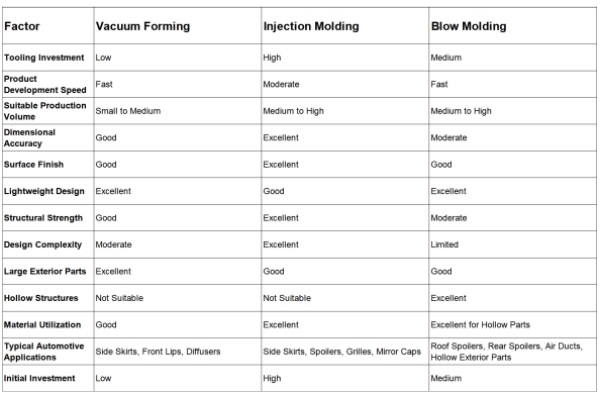
The right choice depends on the project.
When Should You Choose Vacuum Forming?
Vacuum forming may be a good choice when:
◎ The product is relatively large
◎ The design contains broad curved surfaces
◎ Lightweight construction is important
◎ The expected production volume is small or medium
◎ Tooling investment needs to be controlled
◎ The product requires relatively fast development
◎ The vehicle model is a niche or newly emerging application
For many aftermarket side skirt projects, these conditions make vacuum forming a practical manufacturing solution.
When Should You Choose Injection Molding?
Injection molding may be more suitable when:
◎ The expected production volume is very high
◎ Extremely consistent dimensions are required
◎ The design contains complex details
◎ The product requires integrated structural features
◎ High repeatability is essential
◎ The project can support a higher initial tooling investment
For large-scale mass production, injection molding can provide significant advantages.
When Should You Choose Blowing Molding?
◎ Lightweight hollow construction
◎ Excellent material efficiency for enclosed structures
◎ Good impact resistance
◎ Cost-effective production for suitable designs
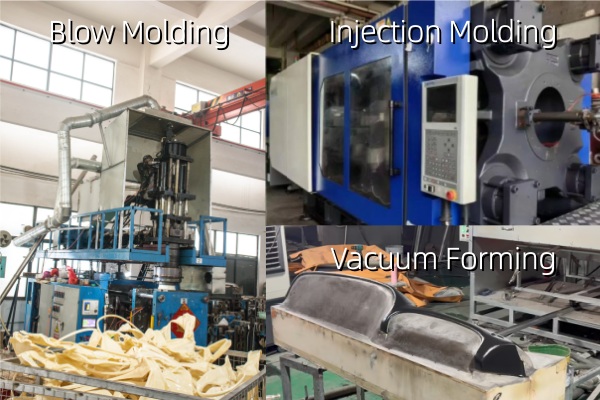
At Haosheng, we do not rely on a single manufacturing technology. Instead, we evaluate each project based on its design, application, production volume, and market requirements. By combining vacuum forming, injection molding, blow molding, CNC machining, and advanced surface finishing, we can recommend the most appropriate manufacturing solution for each automotive exterior component rather than forcing every product into the same production process.
How to Choose a Vacuum Formed Side Skirt Supplier
When choosing a supplier, buyers should look beyond the product price.
Here are several important questions to ask.
1. Can the supplier develop products for specific vehicle models?
Yes, a supplier with vehicle development experience can help reduce fitment problems.
2. Can the supplier provide custom product development?
OEM and ODM capability is important for brands that want to develop unique designs.
3. What manufacturing equipment is available?
A supplier with internal manufacturing capabilities may provide better control over: Molds, Production, CNC processing, Painting, Quality control.
4. Can the supplier support small and large orders?
A flexible supplier can support the product from initial market testing to larger-scale production.
5. Can the supplier provide different surface finishes?
This is important for distributors and brands that want to develop multiple product versions.
6. Does the supplier perform vehicle fitment testing?
This can help identify problems before products are shipped to customers.
How Haosheng Approaches Automotive Exterior Part Manufacturing
At Haosheng, automotive exterior parts are developed with a focus on practical aftermarket requirements.
The development process can involve:
◎ Product research
◎ Vehicle data analysis
◎ 3D product development
◎ Mold development
◎ Plastic forming
◎ CNC processing
◎ Painting and surface finishing
◎ Quality inspection
◎ Vehicle fitment testing
◎ B2B packaging and global delivery
Different automotive exterior products may require different manufacturing processes.
Depending on the product structure, production volume, and customer requirements, manufacturing solutions may include:
◎ Vacuum forming
◎ Injection molding
◎ Blow molding
◎ CNC processing
◎ Painting / Water transfer printing
This approach allows manufacturers to select the appropriate process for the product rather than forcing every product into the same manufacturing method.
For international distributors, automotive brands, tuning shops, and aftermarket retailers, this can provide greater flexibility when developing new products.
Final Thoughts: Is Vacuum Forming the Right Choice for Your Side Skirt Project?
Vacuum forming offers several important advantages for automotive side skirt manufacturing.
Its main benefits include:
◎ Lower tooling investment
◎ Good suitability for large components
◎ Lightweight product construction
◎ Faster product development
◎ Flexibility for small and medium production volumes
◎ Good suitability for aftermarket product development
However, the process also has limitations.
Compared with injection molding, vacuum forming may provide:
◎ Less uniform material thickness
◎ Lower dimensional accuracy in some complex designs
◎ More post-processing requirements
◎ Greater sensitivity to heating and cooling conditions
Therefore, vacuum forming should not be considered universally better or worse than injection molding.
The right manufacturing process depends on the product.
For large, lightweight, relatively smooth automotive side skirts with small-to-medium production requirements, vacuum forming can be an efficient and commercially attractive solution.
For highly complex, high-volume products requiring extremely precise dimensions, injection molding may be more suitable.
The most important factor is choosing a manufacturing partner that understands both the production process and the automotive aftermarket.
If you are developing a new automotive side skirt, body kit component, or other exterior modification product, the manufacturing process should be evaluated together with the product design, target vehicle, expected order volume, and market strategy.
**Looking for a reliable supplier for vacuum formed automotive side skirts or other exterior modification parts?**
Haosheng supports automotive exterior part development, manufacturing, customization, and wholesale supply for distributors, tuning shops, retailers, automotive brands, and aftermarket businesses.
Contact Haosheng team to discuss your vehicle model, product design, target market, and production requirements.
Whatsapp: +86 181 0150 5045
E-mail: ella@hsspoiler.com