Poland Automotive Exterior Modification Market 2026: Trends, Opportunities and Automotive Parts Expo
Poland's Automotive Market: Why It Deserves Attention A Mature Used-Car Market Creates More Applications Which Vehicle Segments Could Create Opportunities? The Real Opportunity: Vehicle-Specific Products How Large Is the Polish Exterior Modification Opportunity? Poland's Growing Digital Automotive Aftermarket What Should Polish B2B Buyers Look for in an Exterior Parts Supplier? Why Haosheng Is Looking at the Polish Market Meet Haosheng at Automotive Parts Expo 2026 in Poland What Can Polish Buyers Discuss With Haosheng? Why Poland Can Be More Than a Single-Country Market What Could Shape Poland's Exterior Modification Market Next? Is Poland a Promising Market for Automotive Exterior Accessories? Frequently Asked Questions
Poland has become an increasingly important automotive aftermarket market in Central and Eastern Europe. With more than 21 million registered passenger cars, a relatively old vehicle fleet, a strong used-car import market and a growing digital aftermarket, the country offers opportunities beyond traditional replacement parts. Exterior styling products such as rear spoilers, roof spoilers, front lips, rear diffusers, side skirts and other vehicle-specific accessories can serve a broader market of distributors, tuning businesses, online sellers and automotive accessory retailers.
In October 2026, Changzhou Haosheng Vehicle Parts Co., Ltd. will travel to Poland to participate in Automotive Parts Expo 2026 at Ptak Warsaw Expo. This exhibition provides an opportunity to meet local automotive aftermarket professionals, understand regional product preferences and explore cooperation with Polish and Central European buyers.
Poland's Automotive Market: Why It Deserves Attention
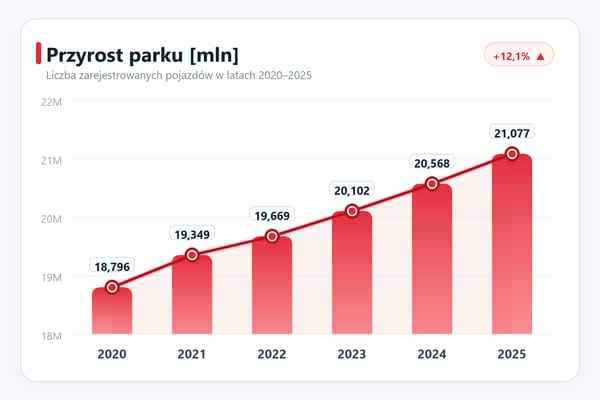
Poland is one of the more important automotive markets in Central and Eastern Europe. Its significance is not based on new-car sales alone. The country's large installed vehicle base creates a substantial aftermarket ecosystem covering maintenance, repair, replacement parts, accessories and vehicle customization.
According to Statistics Poland, there were 601 passenger cars per 1,000 inhabitants in Poland in 2026, placing it ahead of Germany but behind Luxembourg and Cyprus.
More importantly for aftermarket businesses, Poland has a relatively old passenger-car fleet.
Eurostat's latest vehicle-age data shows that 35.1% of passenger cars in Poland were 20 years old or more, based on the latest available Polish data reported for 2024. Poland was among the EU countries with the highest shares of very old passenger cars.
At the end of 2025, IBRM Samar reported approximately 21.08 million registered passenger cars in Poland, with an average passenger-car age of 16.24 years.
These figures matter because an established vehicle fleet supports a long aftermarket lifecycle.
A vehicle does not stop generating business opportunities when it leaves the new-car showroom. It may subsequently require replacement components, maintenance, cosmetic renewal, accessories and styling upgrades for many years.
For exterior accessory suppliers, this creates an interesting environment:
Large vehicle population → long vehicle ownership/use cycle → established aftermarket → demand for vehicle-specific products.
Beyond Replacement Parts: Where Does Exterior Modification Fit?
The Polish automotive aftermarket should not be viewed only through the traditional categories of brakes, filters, suspension components and mechanical replacement parts.
There is another layer of demand: vehicle personalization. A car owner may want to change the appearance of an existing vehicle without replacing the vehicle itself.
This can include:
● Rear spoilers
● Roof spoilers
● Front lips
● Rear diffusers
● Side skirts
● Mirror caps
● Front grilles
● Rear window louvers
● Fender extensions
● Small body kits
● Other vehicle-specific exterior accessories
These products occupy an interesting position between conventional replacement parts and full-scale performance modification.
They can provide a visible styling change without requiring the customer to undertake a major mechanical modification.
That distinction is important when evaluating the Polish market.
The opportunity is not necessarily limited to professional racing or extreme tuning projects. A daily-use Volkswagen, BMW, Audi, Skoda, Toyota, Ford, Hyundai or Kia can also become a candidate for exterior personalization.
A Mature Used-Car Market Creates More Applications
Another important characteristic of Poland is its substantial used-vehicle market.
In 2025, Poland registered 855,587 imported used passenger cars, according to data summarized by IBRM Samar. Total imported used passenger cars and light commercial vehicles up to 3.5 tonnes reached 948,461 vehicles.
Germany remained by far the largest source of imported vehicles, with 492,740 vehicles imported in 2025, followed by France and the United States. Volkswagen, Ford and Opel were among the leading passenger-car brands in the imported used-car market.
This is relevant to exterior accessories for one simple reason:
A large used-car population creates a wide range of vehicle applications.
Older European models can remain commercially relevant for years after their original launch. If distributors and tuning shops can identify models with sufficient local demand, vehicle-specific exterior products may continue to have sales potential even when the original vehicle is no longer a new-car model.
For manufacturers, this means product development should not focus exclusively on the newest vehicles.
There can also be opportunities in:
● Popular European models from previous generations
● Used premium vehicles
● Hatchbacks with established tuning communities
● SUVs and crossovers
● Vehicles with multiple facelift generations
● Models imported from other European markets
This is one reason why a large product database can be valuable to B2B buyers.
Which Vehicle Segments Could Create Opportunities?
There is no single "Polish tuning car."
The market is fragmented across vehicle brands, generations, price levels and customer preferences.
For an exterior accessory supplier, it is more useful to divide the market into several application groups.
1. European Mainstream Vehicles
European brands have an established presence in Poland and across Central and Eastern Europe.
Potential product applications include vehicles from:
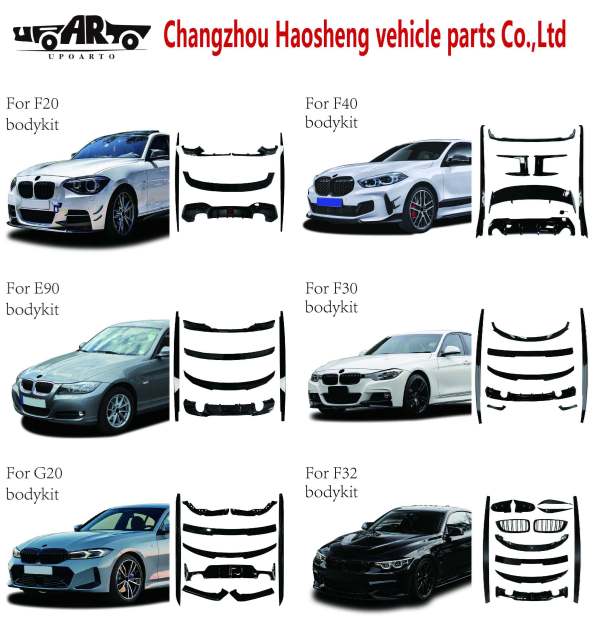
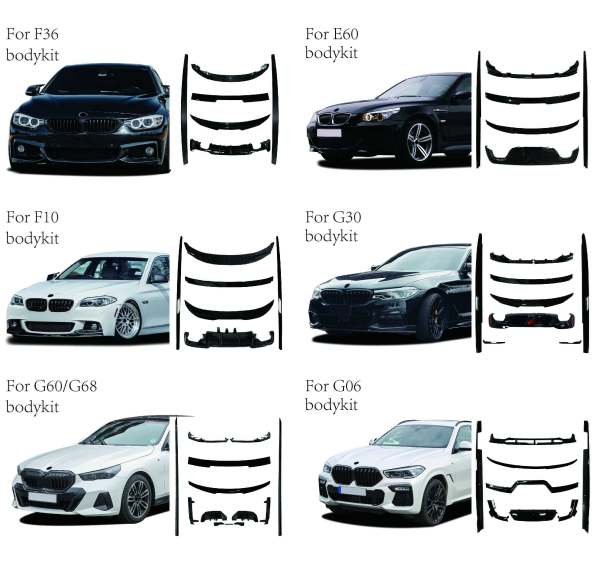
● Volkswagen
● BMW
● Audi
● Mercedes-Benz
● Skoda
● Opel
● Ford
● Renault
● Peugeot
For these vehicles, buyers may look for products ranging from relatively simple rear spoilers to complete exterior styling packages.
2. Japanese and Korean Vehicles
Japanese and Korean vehicles also create opportunities for vehicle-specific accessories.
Examples include:
● Toyota
● Honda
● Mazda
● Suzuki
● Hyundai
● Kia
The commercial opportunity is not necessarily determined by the overall number of vehicles on the road.
A smaller vehicle application can still be interesting if there is:
● Strong enthusiast demand
● Limited local supply
● Few competing designs
● Good online search demand
● A suitable selling price
● A distributor willing to develop the niche
This is particularly relevant to manufacturers with flexible mold-development capabilities.
3. SUVs and Crossovers
SUVs and crossovers deserve special attention.
Their larger body surfaces provide more opportunities for exterior styling products, including:
● Roof spoilers
● Rear spoilers
● Front lips
● Side skirts
● Rear diffusers
● Fender extensions
● Grilles
● Roof accessories
As vehicle manufacturers continue to introduce SUVs, crossovers and electrified models, exterior accessory suppliers also have opportunities to develop new applications.
The challenge is timing.
A supplier that enters the market too late may face intense competition. A supplier that can identify an emerging vehicle early and develop a suitable product can potentially establish a position before the application becomes crowded.
The Real Opportunity: Vehicle-Specific Products
One of the biggest differences between generic accessories and vehicle-specific exterior parts is fitment.
A universal accessory can potentially serve many vehicles, but it also competes with a large number of alternatives.
A vehicle-specific spoiler has a narrower application, but the customer knows exactly what vehicle it is designed for.
For B2B buyers, this creates a different commercial model.
A distributor may not need one product that fits every car.
Instead, it may need: the right product for the right vehicle generation at the right price.
That makes product coverage extremely important.
For example, a supplier with multiple designs for different generations of the same vehicle can provide more opportunities than a supplier offering only one universal style.
This is particularly relevant to models with:
● Multiple generations
● Pre-facelift and facelift versions
● Different body styles
● Different trim levels
● Different regional specifications
Fitment information therefore becomes part of the product itself.
How Large Is the Polish Exterior Modification Opportunity?
It is tempting to answer this question with a single market-size number.
However, for an exterior accessory manufacturer, that can be misleading.
The entire Polish automotive aftermarket includes many categories that have little direct relationship with spoilers or body styling.
A more useful approach is to divide the opportunity into layers.
TAM: Poland's Automotive Aftermarket
This includes the complete aftermarket ecosystem:
● Replacement parts
● Repair
● Maintenance
● Accessories
● Electronics
● Appearance products
● Performance products
SAM: Exterior Accessories and Styling
The addressable segment becomes narrower:
● Car spoilers
● Front ips
● Rear diffusers
● Side skirts
● Front grilles
● Mirror accessories
● Body styling products
Target B2B Market
The next layer includes the customers who can actually distribute these products:
● Automotive parts distributors
● Tuning shops
● Body shops
● Online automotive retailers
● Accessory stores
● Importers
● Regional wholesalers
● Vehicle customization businesses
Product-Level Opportunity
Finally, the most practical question is:
Which vehicle applications can realistically generate repeat orders?
This is where product research, local buyer feedback and supplier flexibility become more important than a headline market-size figure.
For a manufacturer such as Haosheng, the commercial opportunity is therefore better evaluated by vehicle application + buyer type + product category + order potential rather than by the size of the entire Polish automotive aftermarket.
Poland's Growing Digital Automotive Aftermarket
The way automotive products are purchased is also changing.
In July 2026, AUTODOC announced the launch of its Marketplace in Poland. At that time, its marketplace had expanded to 11 European markets and reported 520 sellers, 3.1 million offers and €12.6 million in GMV in Q1 2026.
The importance of this development goes beyond one marketplace.
It demonstrates the increasing role of digital channels in European automotive aftermarket distribution.
For exterior accessory suppliers, online distribution creates several requirements.
Products need to be:
● Easy to identify by vehicle
● Supported by accurate fitment information
● Visually attractive
● Available in multiple finishes where appropriate
● Supported by good product photography
● Packaged for international shipping
● Reliable enough for repeat B2B orders
This creates an opportunity for manufacturers that can provide not only physical products but also the information needed to sell those products online.
What Should Polish B2B Buyers Look for in an Exterior Parts Supplier?
Price is obviously important, but it is not the only factor.
For vehicle-specific exterior accessories, several other factors can determine whether a supplier is commercially useful.
Fitment Development
A supplier should have a process for confirming whether a product actually fits the intended vehicle.
Vehicle data, 3D scanning, mold development and physical fitment testing can all contribute to better results.
Material Selection
ABS and PP are commonly used for automotive exterior styling products, but material selection should depend on the product design and manufacturing process.
For example, injection molding and vacuum forming can produce different product characteristics and cost structures.
Manufacturing Process
The manufacturing process can affect product structure, surface quality, tooling cost, production efficiency and unit cost. For automotive exterior accessories, injection molding, blow molding and vacuum forming are commonly used.
Surface Finishes
B2B buyers may require different finishes depending on their target market:
● Gloss black
● Matte black
● Carbon-fiber-look
● Primer finish
● Other customized finishes
Product Range
A broad product portfolio can allow distributors to test different vehicle applications instead of relying on a single product.
MOQ and Custom Development
For niche vehicle applications, a flexible MOQ and the possibility of developing new molds can be important.
A distributor may discover demand for a product that is not yet available in the supplier's catalog.
In that case, the ability to develop a new application can become a competitive advantage.
Packaging and Logistics
Exterior accessories can be large and relatively lightweight, which makes packaging and freight optimization particularly important.
International buyers may also require different shipping solutions depending on order volume and destination.
Why Haosheng Is Looking at the Polish Market
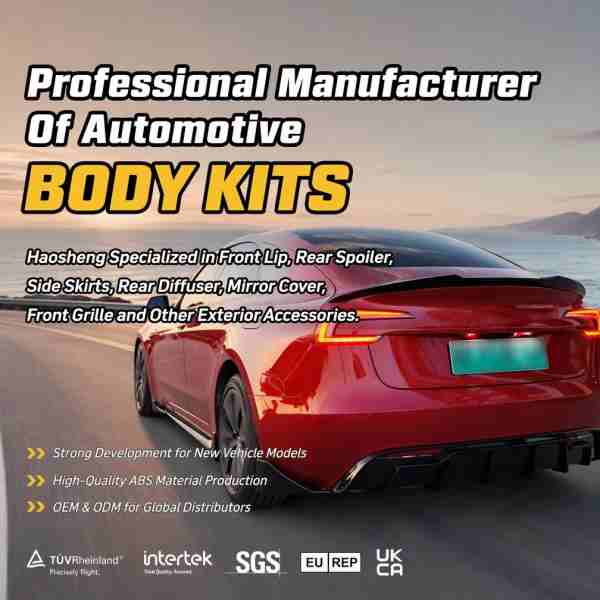
Changzhou Haosheng Vehicle Parts Co., Ltd. is a Chinese automotive exterior accessory manufacturer focused on B2B customers.
Our product portfolio covers more than 2,000 automotive exterior accessory applications, including:
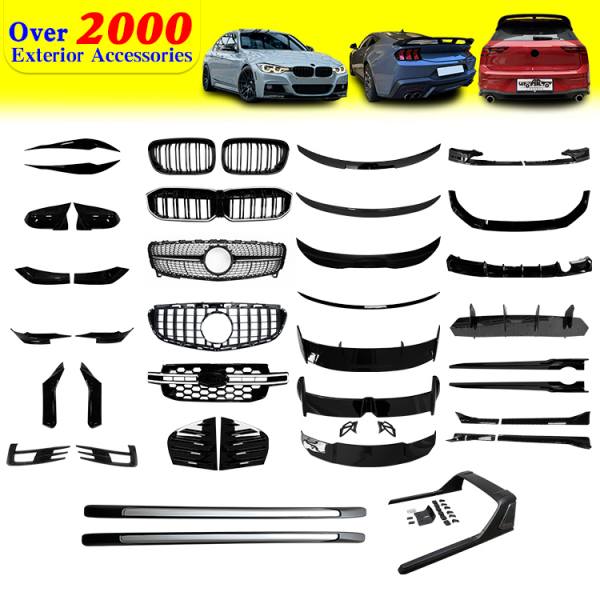
● Rear spoilers
● Roof spoilers
● Front lips
● Rear diffusers
● Side skirts
● Mirror caps
● Rear window louvers
● Front grilles
● Fender extensions
● Small body styling kits
The company focuses on vehicle-specific product development rather than treating automotive exterior accessories as generic universal products.
This approach is particularly relevant to markets such as Poland, where a large and diverse vehicle population creates demand across multiple vehicle generations and applications.
Haosheng also works with customers that require:
● Different product finishes
● Customized packaging
● Vehicle-specific development
● New mold development
● Different materials according to requirements
● Bulk B2B supply
● International shipping arrangements
For a Polish distributor or tuning business, this means cooperation does not necessarily have to start with an existing catalog item.
If a specific vehicle application has sufficient commercial potential, the possibility of developing a new product can also be discussed.
Meet Haosheng at Automotive Parts Expo 2026 in Poland
To gain a closer understanding of the Polish automotive aftermarket and meet potential European business partners, Changzhou Haosheng Vehicle Parts Co., Ltd. will participate in Automotive Parts Expo 2026 in Warsaw, Poland.
The official exhibition information lists the event for October 9–11, 2026, at Ptak Warsaw Expo in Nadarzyn near Warsaw. The organizer describes Automotive Parts Expo as a professional automotive technology trade fair designed to bring together different parts of the automotive technology industry and facilitate business contacts.
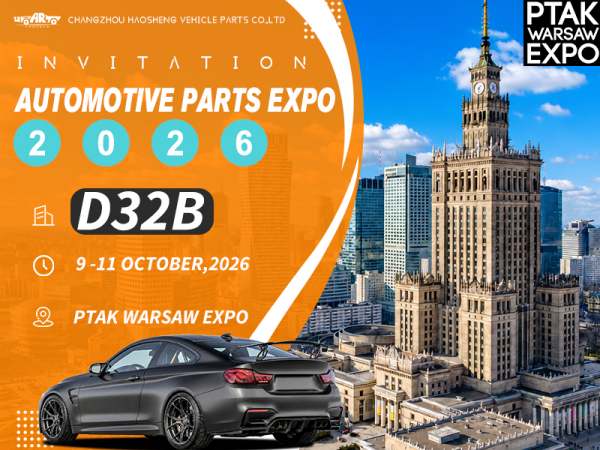
| Exhibition Information Event: Automotive Parts Expo 2026 Date: October 9–11, 2026 Venue: Ptak Warsaw Expo Address: Al. Katowicka 62, 05-830 Nadarzyn, Poland Booth: D32b |
The exhibition is particularly relevant for companies looking for automotive aftermarket products, suppliers and potential business partners. The organizer also highlights networking, industry conferences and opportunities to compare products available in the Polish market.
What Can Polish Buyers Discuss With Haosheng?
Visitors to booth D32b can discuss more than individual products.
Product Sourcing
Discuss existing rear spoilers, roof spoilers, front lips, rear diffusers and other exterior accessories for different vehicle applications.
Distributor Cooperation
For distributors and retailers, discussions can cover:
● Product selection: Haosheng have over two thousand products for our customers to choose from, and we cover a wide range of brands.
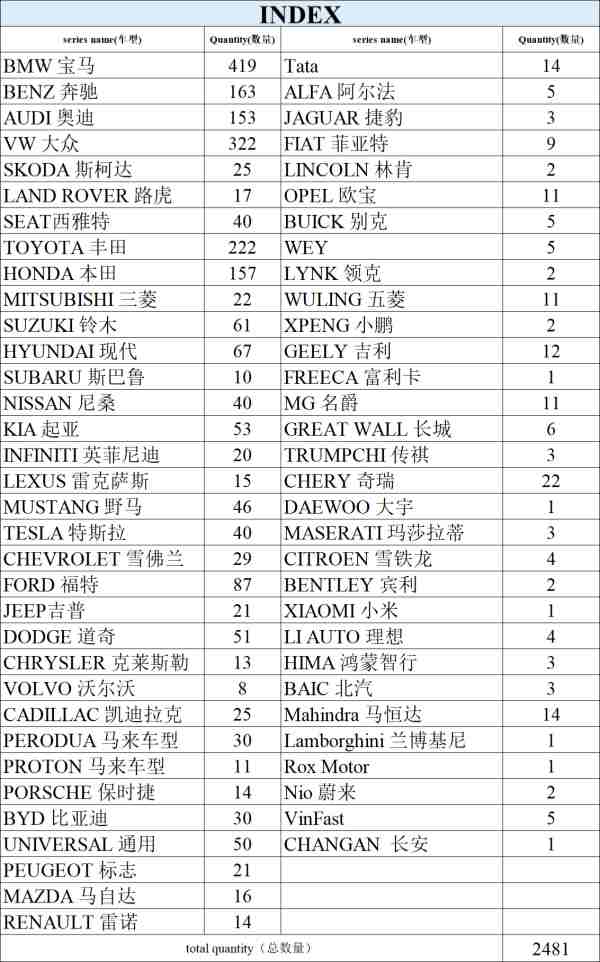
● MOQ: Haosheng supports mixed wholesale.
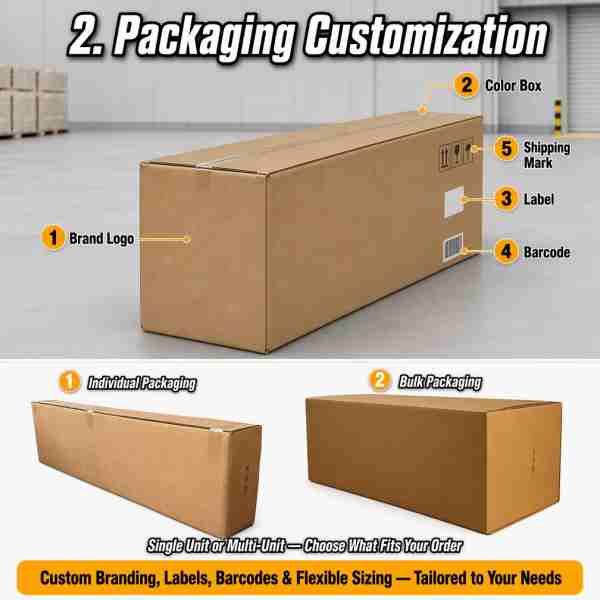
● Packaging: We can accommodate custom packaging requests once a certain order volume is reached.
● Finishes: Unpainted, Primer, Glossy Black, Pearl White, Matt Black, Carbon Fiber Looks.
● Shipping: We can select the mode of transport based on your requirements.
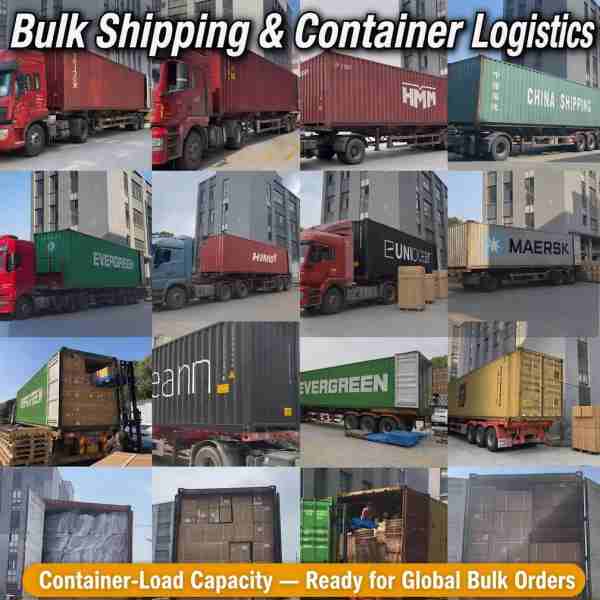
● Long-term supply: We have extensive experience working with clients and our processes are complete and proficient.
New Product Development
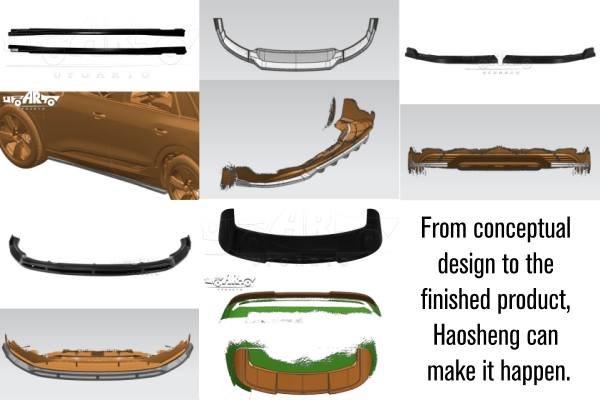
If a vehicle application is commercially interesting but suitable exterior accessories are not currently available, Haosheng can evaluate the possibility of developing a new product and mold.
Market-Specific Product Selection
Different markets can have different styling preferences.
A design that performs well in one country does not automatically have the same potential in another.
Direct communication with local buyers can therefore help identify which vehicle models, styling directions and product price points are worth developing further.
Why Poland Can Be More Than a Single-Country Market
Poland should also be viewed in the context of Central and Eastern Europe.
The European Automobile Manufacturers' Association noted in 2025 that Central and Eastern Europe accounts for approximately one-third of EU vehicle production and employs around two million people across the automotive value chain. The ACEA Central and Eastern European Automotive Hub brings together associations from Czechia, Poland, Romania and Slovakia.
This makes Poland strategically interesting for B2B automotive suppliers.
A Polish distributor may not necessarily serve only customers within Poland. Depending on its business model, it may also have relationships with buyers in neighboring Central and Eastern European markets.
For international manufacturers, therefore, a Polish market strategy can potentially develop into a broader regional strategy.
The relevant markets may include:
● Poland
● Czechia
● Slovakia
● Hungary
● Romania
● Baltic markets
● Other Central and Eastern European markets
The objective is not simply to sell one spoiler in Poland.
It is to understand which products can be scaled across a regional distribution network.
What Could Shape Poland's Exterior Modification Market Next?
Several trends are worth monitoring over the next few years.
1. Older vehicles will remain commercially relevant
Poland's relatively old vehicle fleet means older generations should not be ignored when selecting products.
At the same time, the market is continuously receiving newer vehicles.
This creates a two-layer opportunity: established older applications + newly emerging applications.
2. SUVs and crossovers will continue to create styling opportunities
Their body design provides numerous areas for exterior personalization.
This can support demand for:
● Roof spoilers
● Rear spoilers
● Front lips
● Diffusers
● Side skirts
● Grilles
● Fender accessories
3. New-energy vehicles will gradually create new modification applications
The European automotive market is becoming increasingly electrified. ACEA reported that battery-electric vehicles represented 17.4% of EU new-car registrations in 2025, while hybrids accounted for 34.5%.
By May 2026, battery-electric vehicles had reached 20% of EU new-car registrations year-to-date.
As more new-energy vehicles enter the Polish fleet, exterior accessory manufacturers will need to identify which models develop meaningful aftermarket and personalization demand.
This is particularly relevant because many newer EVs have distinctive body designs, making model-specific styling products potentially attractive to owners who want a more individual appearance.
Is Poland a Promising Market for Automotive Exterior Accessories?
The answer is potentially yes, but the opportunity should be evaluated at the product and buyer level rather than through the size of the automotive market alone.
Poland combines several useful conditions:
● A large passenger-car population
● 601 passenger cars per 1,000 inhabitants in 2026
● More than 21 million registered passenger cars at the end of 2025
● A relatively old vehicle fleet
● A large used-car import market
● A developed automotive aftermarket
● Growing digital automotive distribution
● Geographic importance within Central and Eastern Europe
For exterior accessory manufacturers, the opportunity is particularly interesting when these market characteristics are combined with vehicle-specific product development.
Rear spoilers, roof spoilers, front lips, rear diffusers and other exterior accessories do not need to compete for the entire automotive aftermarket.
They need to find the right combination of:
vehicle + styling demand + selling price + distribution channel + reliable supplier.
That is where B2B cooperation becomes important.
Frequently Asked Questions
Q1: Is Poland a good market for automotive aftermarket products?
Poland has a large vehicle population, a relatively old passenger-car fleet and a substantial used-car market, all of which support a broad automotive aftermarket. The opportunity varies significantly by product category and vehicle application.
Q2: Is there a market for car tuning in Poland?
Yes. However, "tuning" should not be understood only as engine or performance modification. Exterior styling and vehicle personalization represent another part of the automotive modification ecosystem, including spoilers, lips, diffusers, grilles and other accessories.
Q3: What automotive exterior accessories can be sold in Poland?
Potential categories include rear spoilers, roof spoilers, front lips, rear diffusers, side skirts, mirror caps, grilles, rear window louvers and other vehicle-specific exterior styling products.
Q4: Are older cars still important to the Polish aftermarket?
Yes. Eurostat reports that 35.1% of passenger cars in the latest available Polish data were at least 20 years old, while IBRM Samar reported an average passenger-car age of 16.24 years at the end of 2025.
Q5: Is Poland important for the Central and Eastern European automotive market?
Poland is part of a broader Central and Eastern European automotive ecosystem. ACEA estimates that Central and Eastern Europe accounts for around one-third of EU vehicle production and approximately two million jobs across the automotive value chain.
Q6: When is Automotive Parts Expo 2026?
Automotive Parts Expo 2026 will take place from October 9 to 11, 2026, at Ptak Warsaw Expo near Warsaw, Poland.
Q7: Where is Automotive Parts Expo 2026 held?
The exhibition will be held at Ptak Warsaw Expo, Al. Katowicka 62, 05-830 Nadarzyn, Poland.
Q8: Where can I meet Haosheng at Automotive Parts Expo 2026?
Changzhou Haosheng Vehicle Parts Co., Ltd. will be exhibiting at Booth D32b.